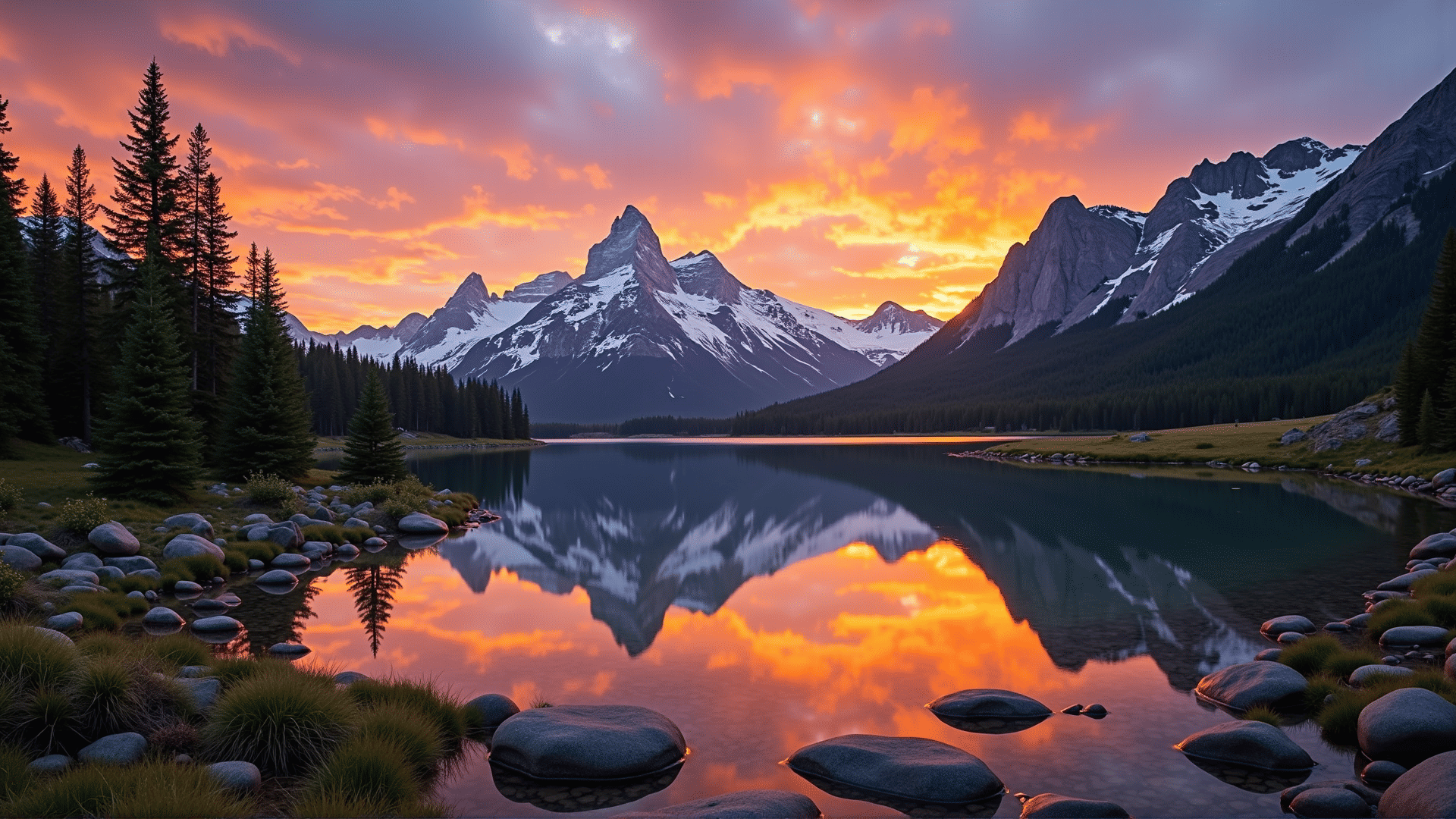
Capturing the majesty of landscapes is a passion for many photography enthusiasts. The art of landscape photography lies not only in joining the beauty of nature but also in creatively using skills to highlight and enhance that beauty. To get the most out of your landscape photography, consider focusing on composition techniques and fine-tuning your camera settings.
Understanding Composition
Rule of Thirds: This classic rule forms the backbone of effective composition. Envision your image divided into nine equal parts, using two equally spaced horizontal and vertical lines. Placing your subject or the horizon at these lines or their intersections cultivates balance and interest. For landscapes, this might mean aligning the horizon with either the top or bottom third, depending on whether you aim to highlight the sky or the ground.
Leading Lines: These are paths within the photograph that direct the viewer’s eye towards the focal point. Roads, rivers, and fences are examples commonly found in nature that can guide the observer into the depth of the scene.
Framing: Use elements available within your landscape to form a natural frame around your main subject. Trees, archways, or even shadows can create a visual frame, adding layers of depth and interest to your composition.
Foreground Interest: Incorporating an element of interest in the foreground can add depth and scale to an image. This can be a rock, plant, or anything else that naturally anchors the eyes before they move onto the background.
Camera Settings for Landscape Photography
Aperture: A small aperture (high f-stop) is typically preferred to achieve a large depth of field, ensuring that both foreground and background are in sharp focus. Experiment with different settings (such as f/8 to f/16) to find the ideal sharpness.
ISO: Keeping your ISO low (like ISO 100) is crucial to minimize noise, especially since landscapes are often best captured with lots of detail. However, in low-light situations, you may need to increase ISO while balancing it with other settings to avoid graininess.
Shutter Speed: Adjusting shutter speed according to the scene's dynamism is essential. Use slower shutter speeds for capturing the soft movement of water or clouds, using a tripod to eliminate camera shake. Conversely, faster shutter speeds are necessary when dealing with moving subjects or if you're shooting handheld.
White Balance: Manually setting your white balance or using the appropriate preset for the lighting conditions can impact the color accuracy of your shots, ensuring they represent the real-world scene you witnessed.
Finding the Right Light
Lighting is paramount in landscape photography. The golden hours shortly after sunrise and just before sunset are particularly advantageous. During these times, the light is softer and the shadows longer, adding a magical touch that enhances textures and colors.
Seeking Unique Perspectives
Don't hesitate to experiment with unusual angles or heights. Sometimes crouching low or finding a high vantage point can transform a familiar scene into something unforgettable. Moving around the environment, even slightly, might unveil a perspective that tells a better story.
Embracing Post-Processing
Post-processing should be seen as an extension of your creativity, a tool to enhance the elements that moved you to capture the scene. Adjusting exposure, contrast, and colors can bring out details and enhance the mood without deviating from the essence of the landscape.
In conclusion, shooting landscapes is a rewarding journey that combines the exploration of nature with the art of photography. By focusing on composition, fine-tuning camera settings, embracing lighting, and utilizing post-processing effectively, photographers can craft images that resonate and inspire. With practice and experimentation, your ability to capture the essence of a landscape will continue to grow, resulting in breathtaking visual narratives.